What Does "Clinically Studied" Actually Mean on a Supplement Label?
By Priya Ramaswamy, RD · 4 min read · April 23, 2026
Walk through the supplement aisle of any pharmacy and you'll see the phrase everywhere: "clinically studied." On bottles of magnesium. On perimenopause formulas. On probiotic gummies. On collagen powders.
It sounds reassuring. It implies science, rigor, and results. And in the supplement industry, it is so consistently deployed and so rarely defined that most consumers have no idea what it actually means.
Here's the truth: "clinically studied" can mean almost anything. Understanding how to decode it is one of the most valuable skills a health-conscious consumer can develop.
What "Clinically Studied" Does Not Mean
Let's start with what the phrase does not guarantee:
It does not mean the finished product was studied. An ingredient can be classified as "clinically studied" based on a study of that compound in isolation, at a dose that bears no relationship to what's in the product on the shelf. The formula as a whole may have never been tested on anyone.
It does not mean the study population matches you. A study conducted on postmenopausal women tells you something different than one conducted on perimenopausal women. A study conducted on men tells you something different again. Research on one population does not automatically transfer to another.
It does not mean the dose is equivalent. This is one of the most important gaps in supplement labeling. An ingredient might be studied at 400mg in the clinical literature -- but present at 50mg in the product. The label says "clinically studied." The dose is not.
It does not mean the study was well-designed. A study with 12 participants, no control group, and industry funding is technically a study. It exists. The ingredient can say "as studied in clinical research." The quality of that research may be essentially worthless.
It does not mean the study was published in a peer-reviewed journal. Unpublished internal studies, conference posters, and industry-sponsored white papers are all "clinical research" in a loose sense. They are not peer review.
What Actually Matters: A Framework for Evaluating Claims
Instead of looking for "clinically studied" as a quality signal, here are the questions that actually distinguish rigorous formulas from marketing-dressed products.
1. Is the evidence peer-reviewed and indexed?
Peer-reviewed research, published in indexed journals and searchable on PubMed, is the gold standard. It means the research has been independently evaluated by experts in the field before publication. It means the methodology, sample size, and conclusions have been scrutinized.
A brand that cites specific PubMed study IDs for its formulation ingredients -- not vague references to "clinical research" -- is operating at a fundamentally different standard of transparency than one that doesn't.
2. Are the doses in the product consistent with the studied doses?
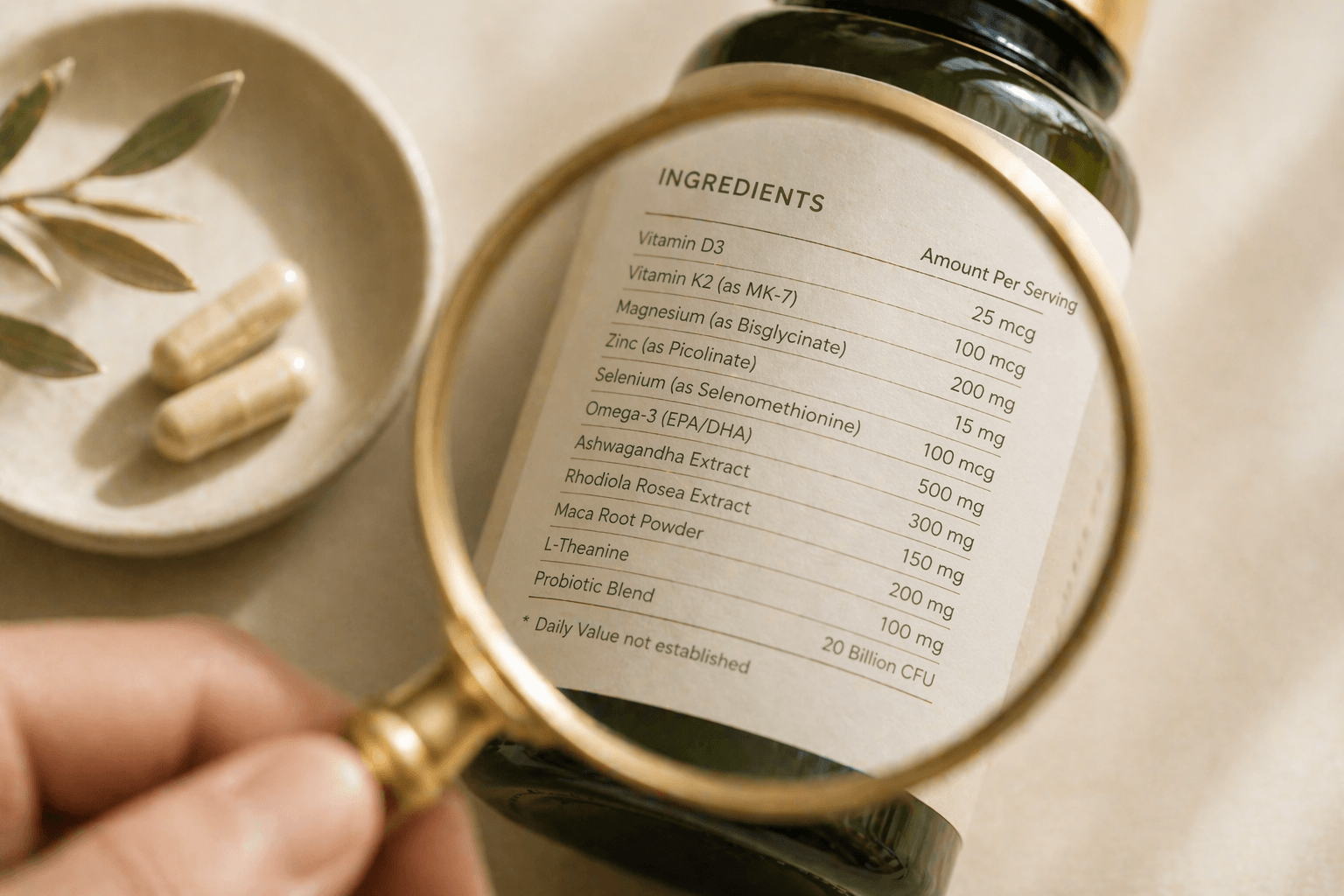
This requires a bit of work, but it's worth it. Look up the key studies behind a product's main ingredients. Check the doses used in the research. Compare them to what the supplement label discloses.
If the label uses a "proprietary blend" that doesn't disclose individual ingredient amounts, that is a meaningful red flag. Proprietary blends exist, in most cases, to obscure the fact that ingredients are present in amounts too small to produce the studied effects.
3. Was the research conducted in the right population?
For perimenopause-specific products, this is especially important. Look for studies conducted on perimenopausal or menopausal women, not just on general adult populations or animal models. Hormonal biology is sex-specific and stage-specific. Evidence from the right population is meaningfully more relevant.
4. Who funded the research?
Industry-funded research is not automatically invalid. But it warrants a higher level of scrutiny. Independent research -- conducted at universities or medical centers without industry sponsorship -- is generally more credible.
5. How many independent studies support the ingredient?
A single study, even a well-designed one, is preliminary evidence. Multiple independent studies producing consistent results -- conducted by different researchers, in different settings, with different populations -- is where scientific confidence builds.
When a formula is backed by dozens of independent, PubMed-indexed studies across its core ingredients, that is a qualitatively different level of evidence than "as seen in one company-sponsored clinical trial."
The "Fairy Dust" Problem
In the supplement industry, there is a practice sometimes called "fairy dusting": adding a well-known ingredient to a formula at a quantity too small to have any physiological effect, then listing it prominently on the label.
The purpose is marketing, not efficacy. The ingredient name carries brand recognition. The dose doesn't matter, because the dose is never disclosed.
The solution is demanding label transparency: full disclosure of every ingredient amount, no proprietary blends for key actives, and specific references to the research supporting each ingredient at its stated dose.
What "Clinically Backed" Should Look Like
A formula genuinely built on clinical evidence would be able to answer the following, publicly and specifically:
Here are the peer-reviewed, PubMed-indexed studies supporting each active ingredient.
Here are the doses used in those studies.
Here are the doses in our formula.
They match.
That level of transparency is not industry standard. It is, however, what separates a formula built around the evidence from one built around the appearance of evidence.
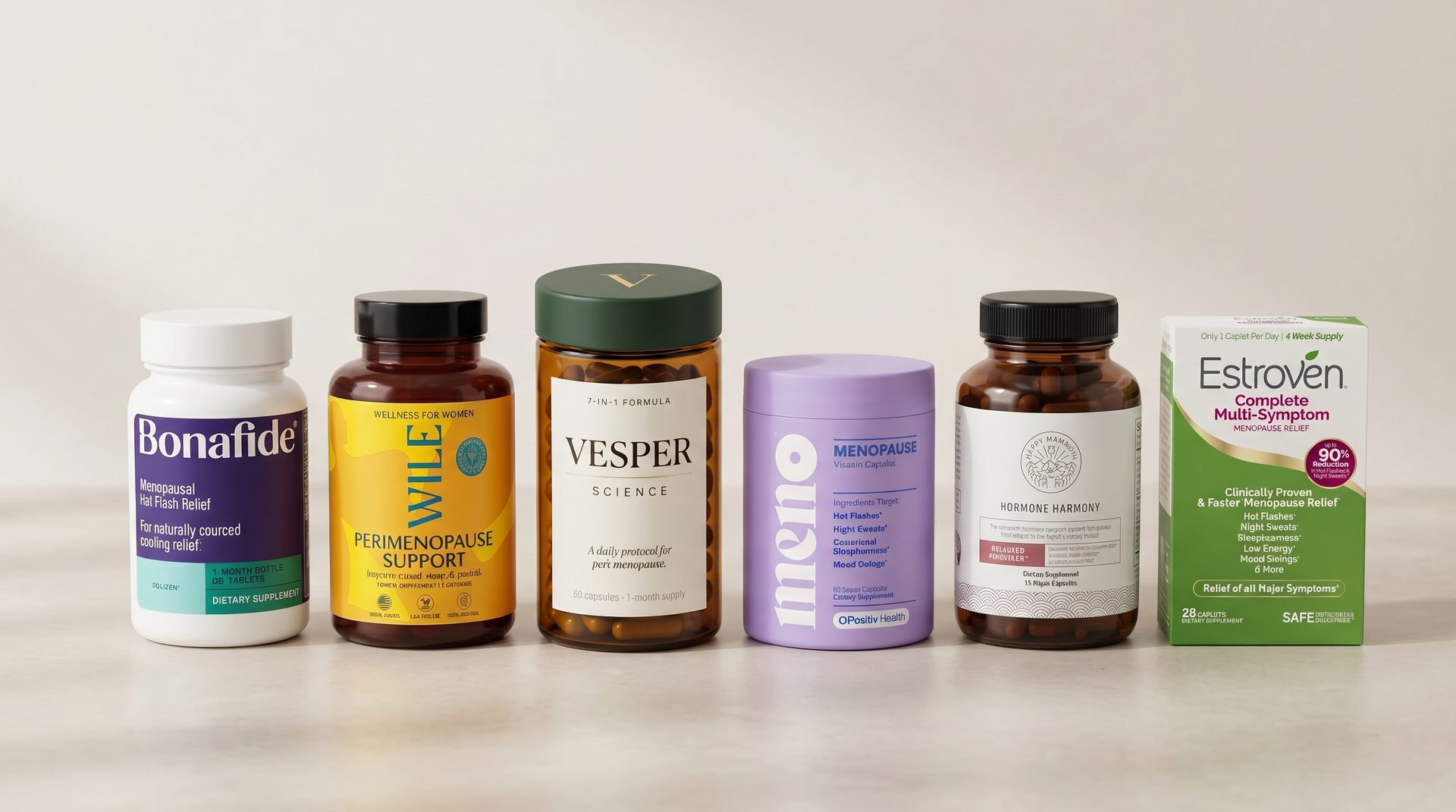
If you're evaluating perimenopause supplements and want a clearer picture of how different products stack up on criteria that actually matter, our comparison table and 3-minute quiz are a useful starting point.
This article is for educational purposes only. Always consult a healthcare provider before beginning any supplement regimen.